CRYSTAL COMMUNICATIONS MYSTERY


Chapter One – Sparks in the Desert

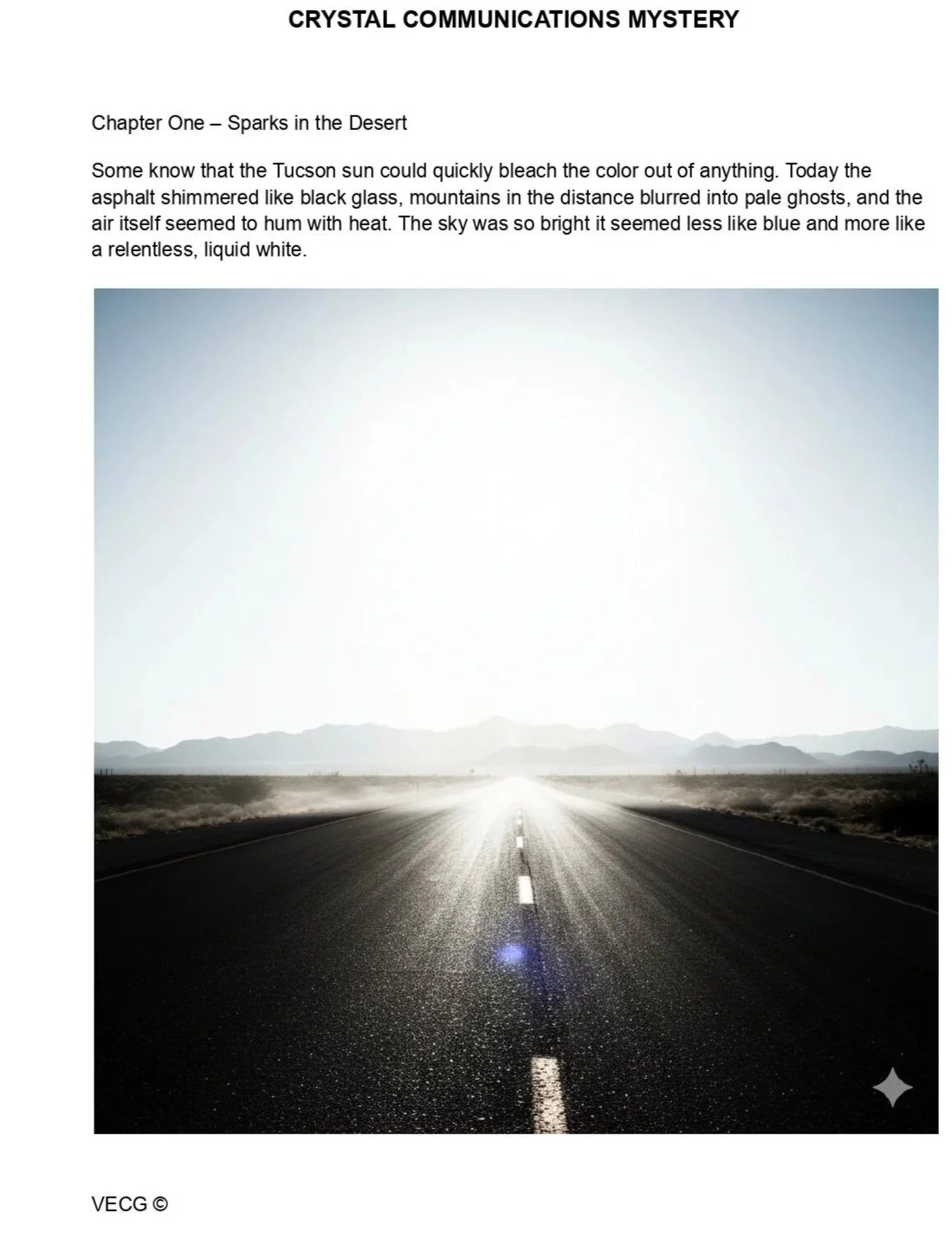
Some know that the Tucson sun could quickly bleach the color out of anything. Today the asphalt shimmered like black glass, mountains in the distance blurred into pale ghosts, and the air itself seemed to hum with heat. The sky was so bright it seemed less like blue and more like a relentless, liquid white.

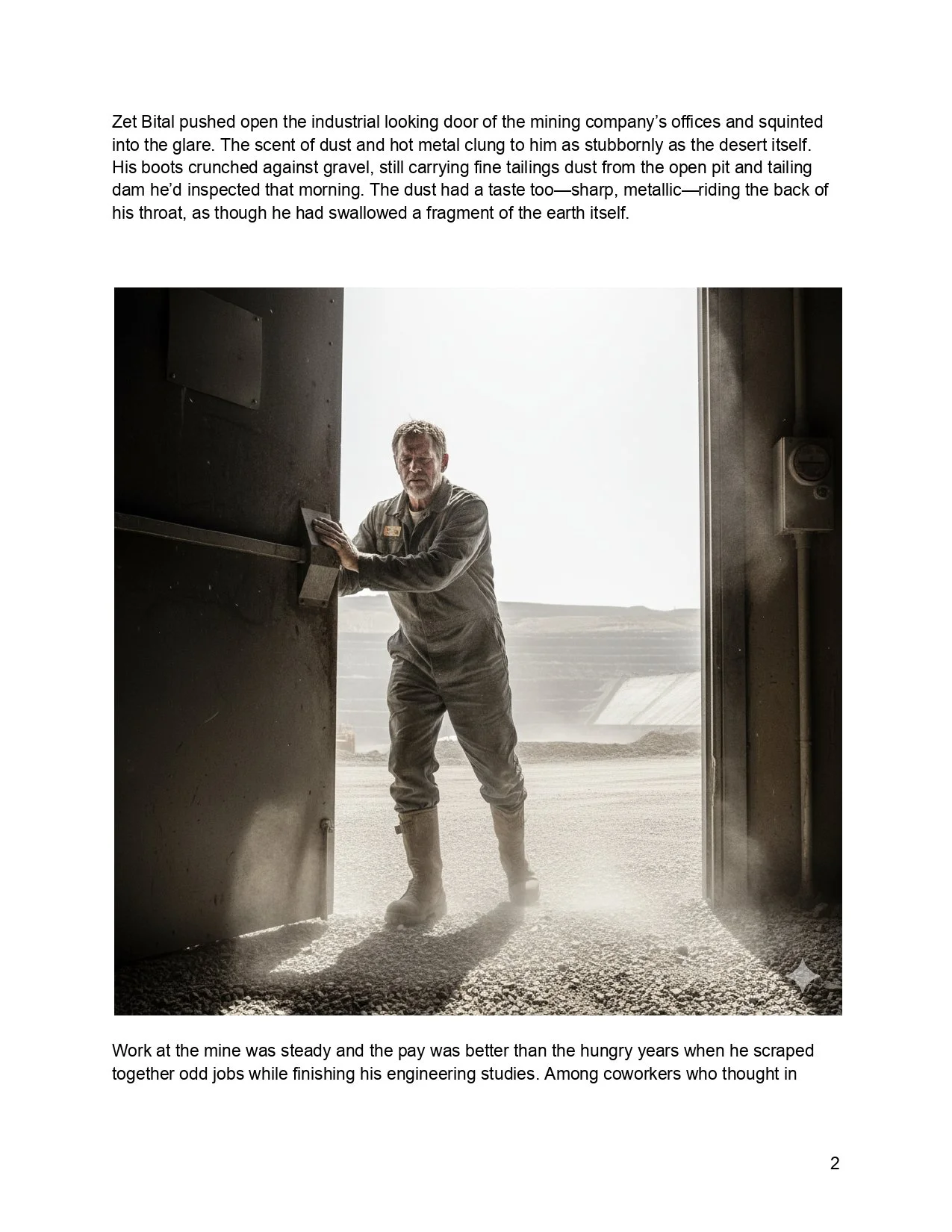
Zet Bital pushed open the industrial looking door of the mining company’s offices and squinted into the glare. The scent of dust and hot metal clung to him as stubbornly as the desert itself. His boots crunched against gravel, still carrying fine tailings dust from the open pit and tailing dam he’d inspected that morning. The dust had a taste too—sharp, metallic—riding the back of his throat, as though he had swallowed a fragment of the earth itself.


Work at the mine was steady and the pay was better than the hungry years when he scraped together odd jobs while finishing his engineering studies. Among coworkers who thought in terms of ore grades, yields, and environmental impacts, Zet was inadvertently  a specialist—a quiet thinker who could see meaning in the patterns others ignored.

Among many insights on construction of mine facilities and other work related perceptions, for Zet, crystals found embedded in the mine walls had to have some occult properties. Their fractures, their angles, their glittering imperfections spoke like dialects of a hidden language. He often wondered: what secrets lay compressed inside them, what stories remained frozen in lattices that had grown in darkness for millions of years? There should be reasons why molecules structure themselves in such patterns, from the past and for the future. 


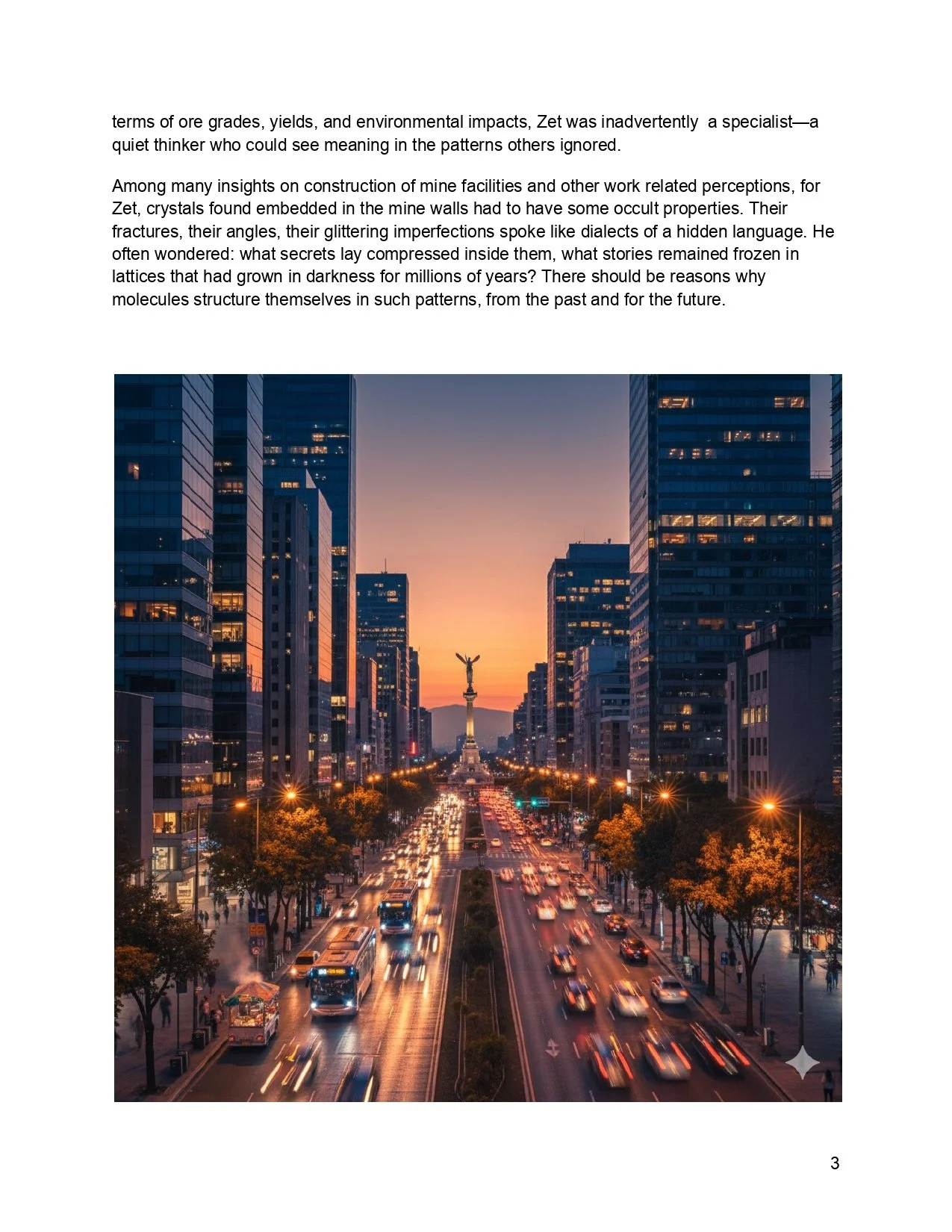
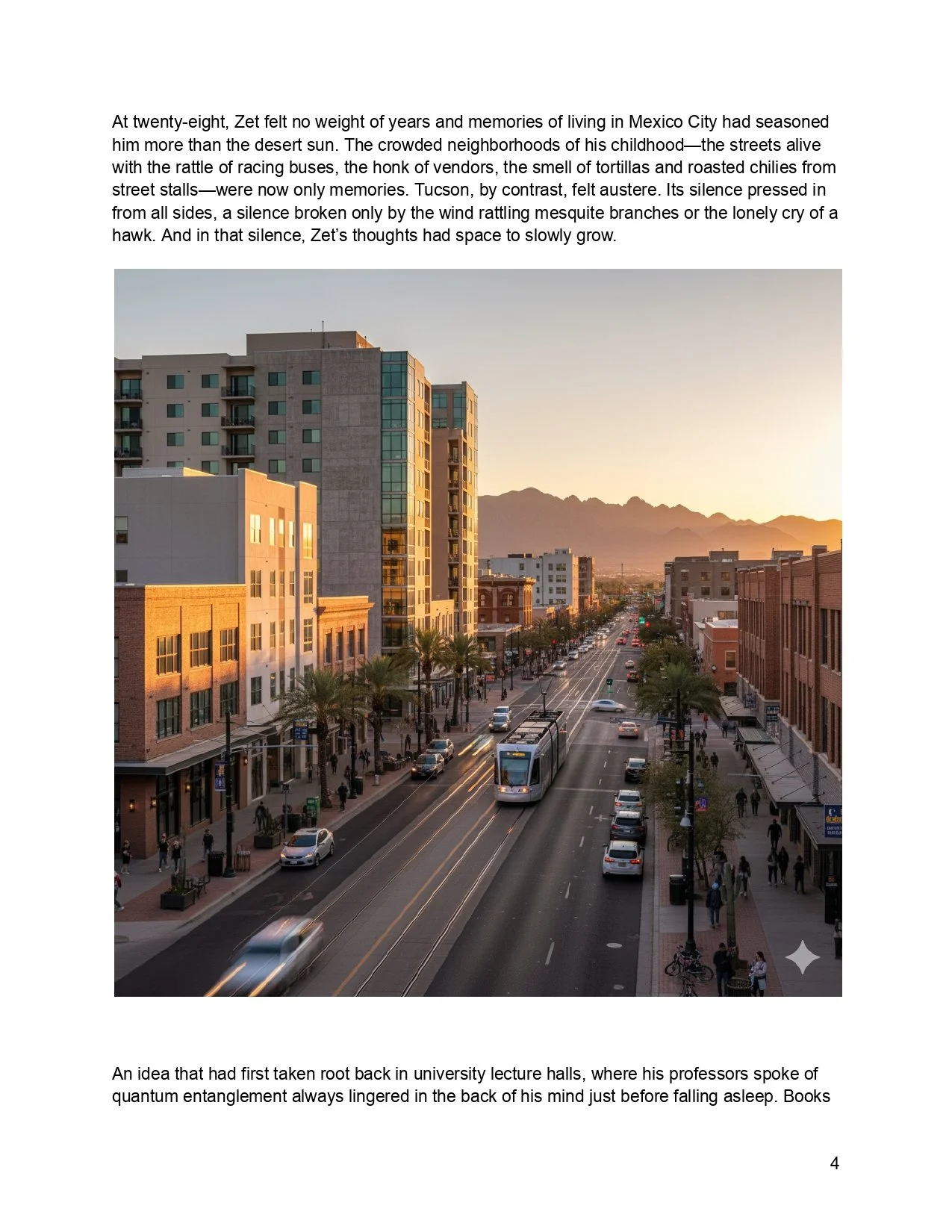
At twenty-eight, Zet felt no weight of years and memories of living in Mexico City had seasoned him more than the desert sun. The crowded neighborhoods of his childhood—the streets alive with the rattle of racing buses, the honk of vendors, the smell of tortillas and roasted chilies from street stalls—were now only memories. Tucson, by contrast, felt austere. Its silence pressed in from all sides, a silence broken only by the wind rattling mesquite branches or the lonely cry of a hawk. And in that silence, Zet’s thoughts had space to slowly grow.


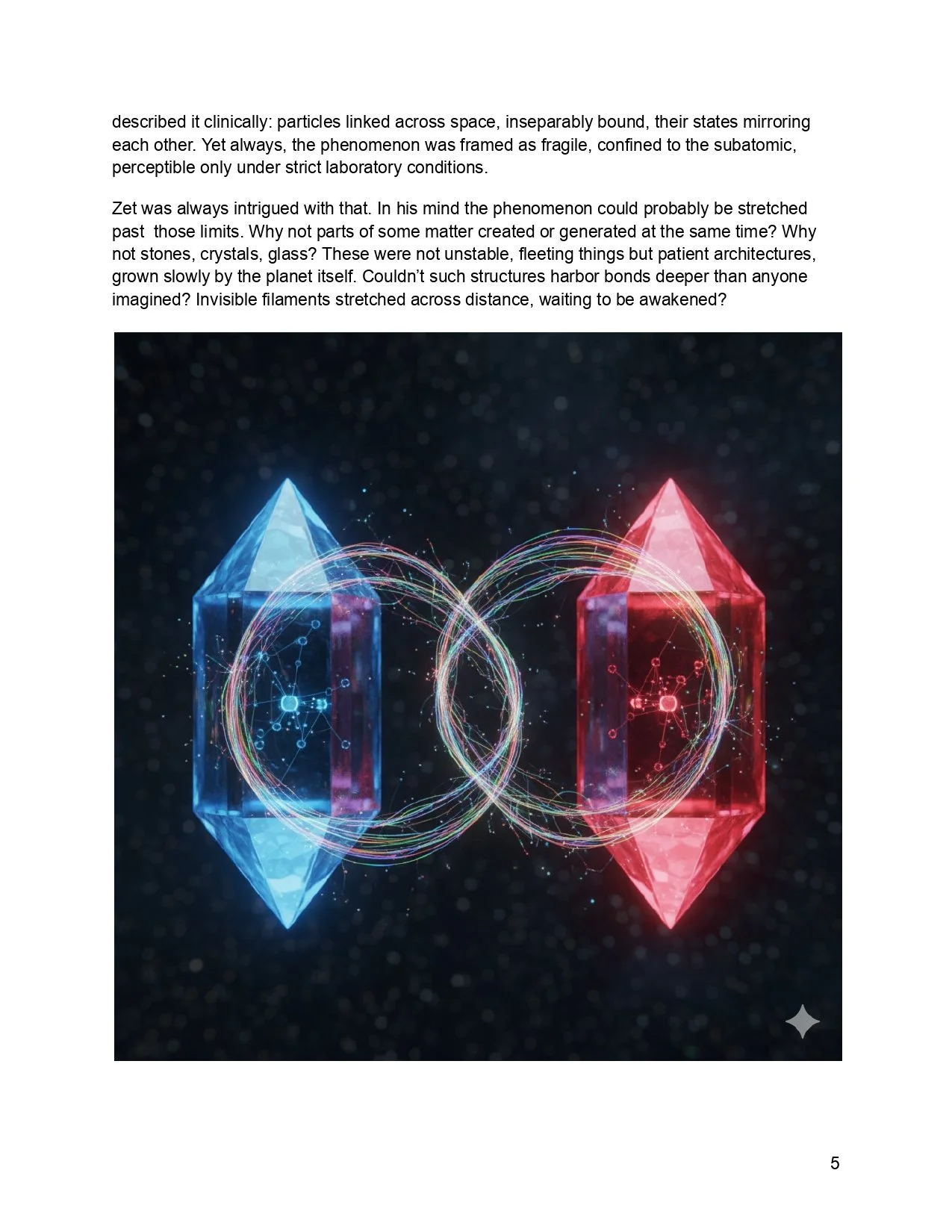
An idea that had first taken root back in university lecture halls, where his professors spoke of quantum entanglement always lingered in the back of his mind just before falling asleep. Books described it clinically: particles linked across space, inseparably bound, their states mirroring each other. Yet always, the phenomenon was framed as fragile, confined to the subatomic, perceptible only under strict laboratory conditions.

Zet was always intrigued with that. In his mind the phenomenon could probably be stretched past  those limits. Why not parts of some matter created or generated at the same time? Why not stones, crystals, glass? These were not unstable, fleeting things but patient architectures, grown slowly by the planet itself. Couldn’t such structures harbor bonds deeper than anyone imagined? Invisible filaments stretched across distance, waiting to be awakened?


He had never confessed this theory to anyone. Thinking that to physicists, the theory would seem naïve, perhaps laughable. To engineers, it would sound like madness. And so it lived in his private hours—ideas scribbled in notebooks, equations trailing into sketches of crystal lattices.

As he crossed the furnace-hot parking lot toward his white Crown Vic, the thought returned, vivid as ever. If crystals or glass could resonate across distance, will the transmission be discernible?

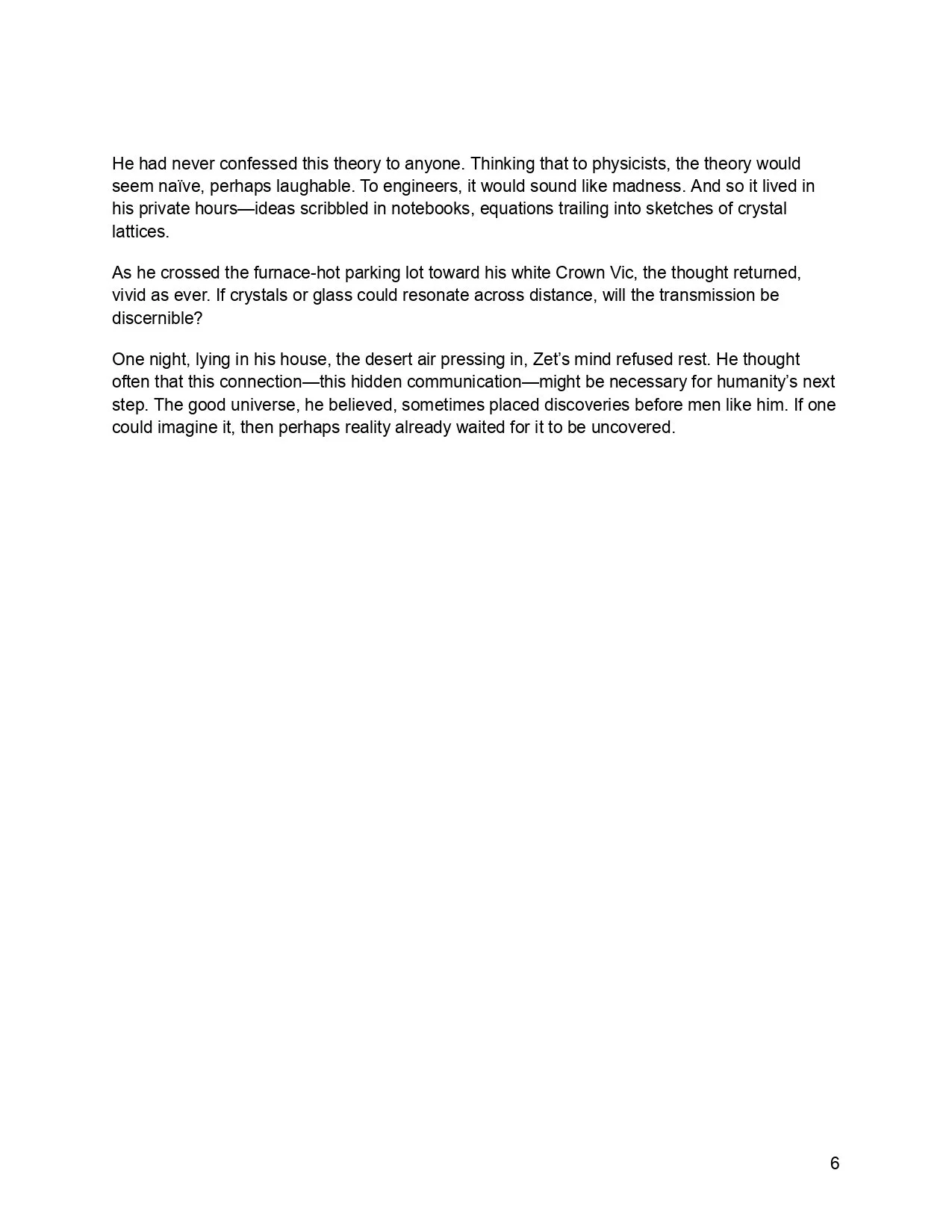
One night, lying in his house, the desert air pressing in, Zet’s mind refused rest. He thought often that this connection—this hidden communication—might be necessary for humanity’s next step. The good universe, he believed, sometimes placed discoveries before men like him. If one could imagine it, then perhaps reality already waited for it to be uncovered.


Yet in the silence of those long hours, the only tangible possibility he could foresee was something small and immediate—money. A quick fortune, perhaps, a stroke of luck that might prove the link between thought and outcome. The lottery came to mind, its promise absurd yet irresistible. Though he knew the chances were almost nonexistent, Zet began to bet, half in jest, half in faith that the universe might whisper back through numbers and chance.

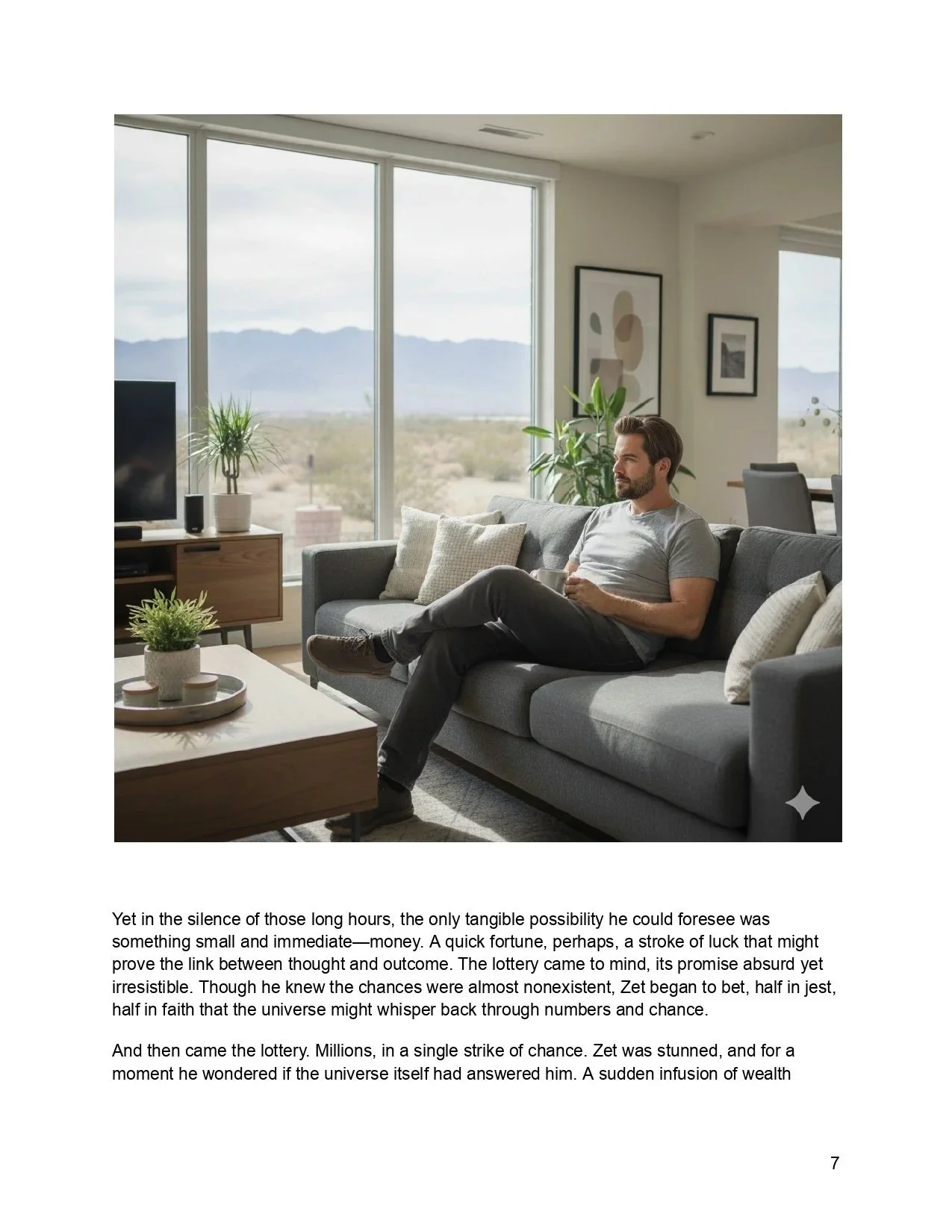
And then came the lottery. Millions, in a single strike of chance. Zet was stunned, and for a moment he wondered if the universe itself had answered him. A sudden infusion of wealth meant he could build what he dreamed: the laboratory, the equipment, the time to pursue it without compromise.

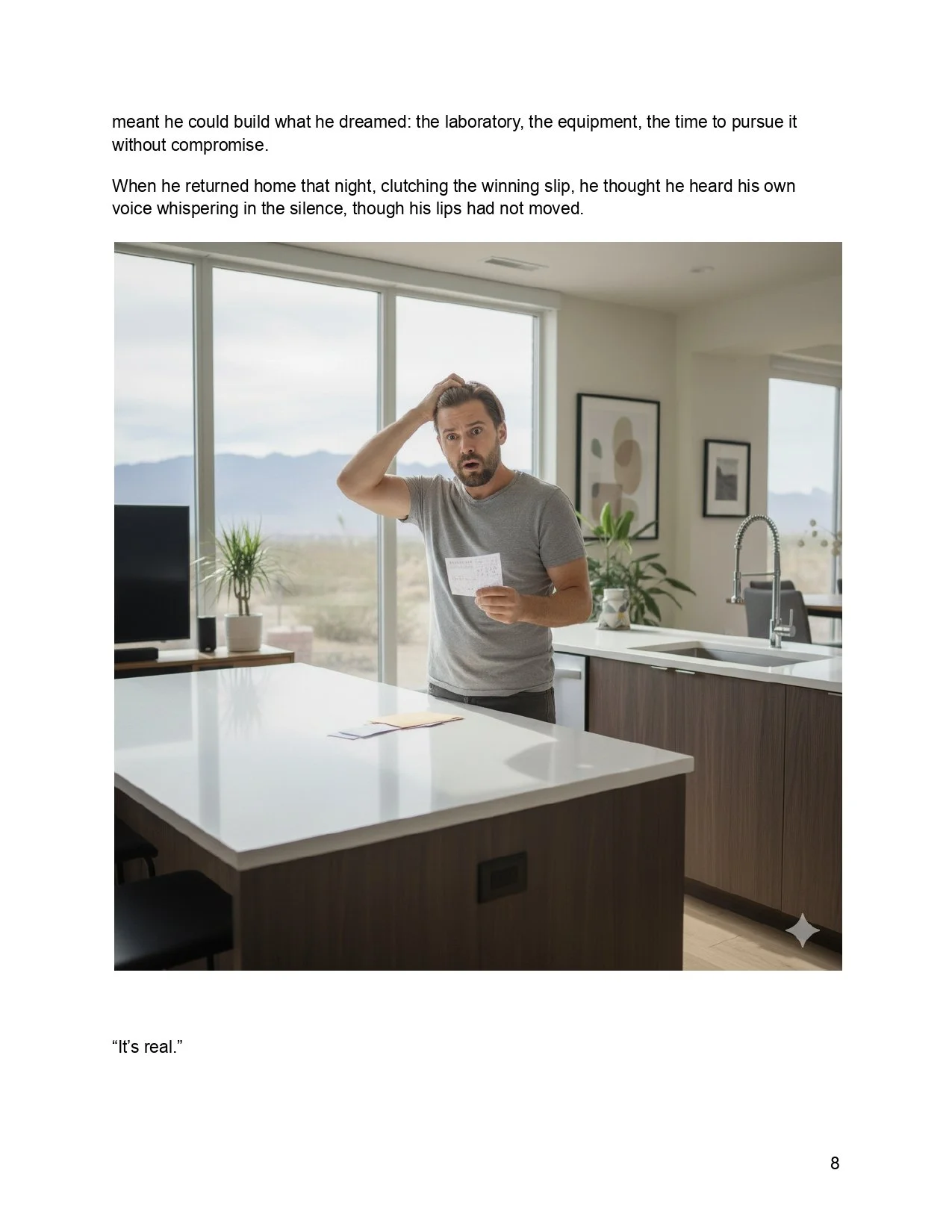
When he returned home that night, clutching the winning slip, he thought he heard his own voice whispering in the silence, though his lips had not moved.


“It’s real.”


Chapter Two – The Laboratory

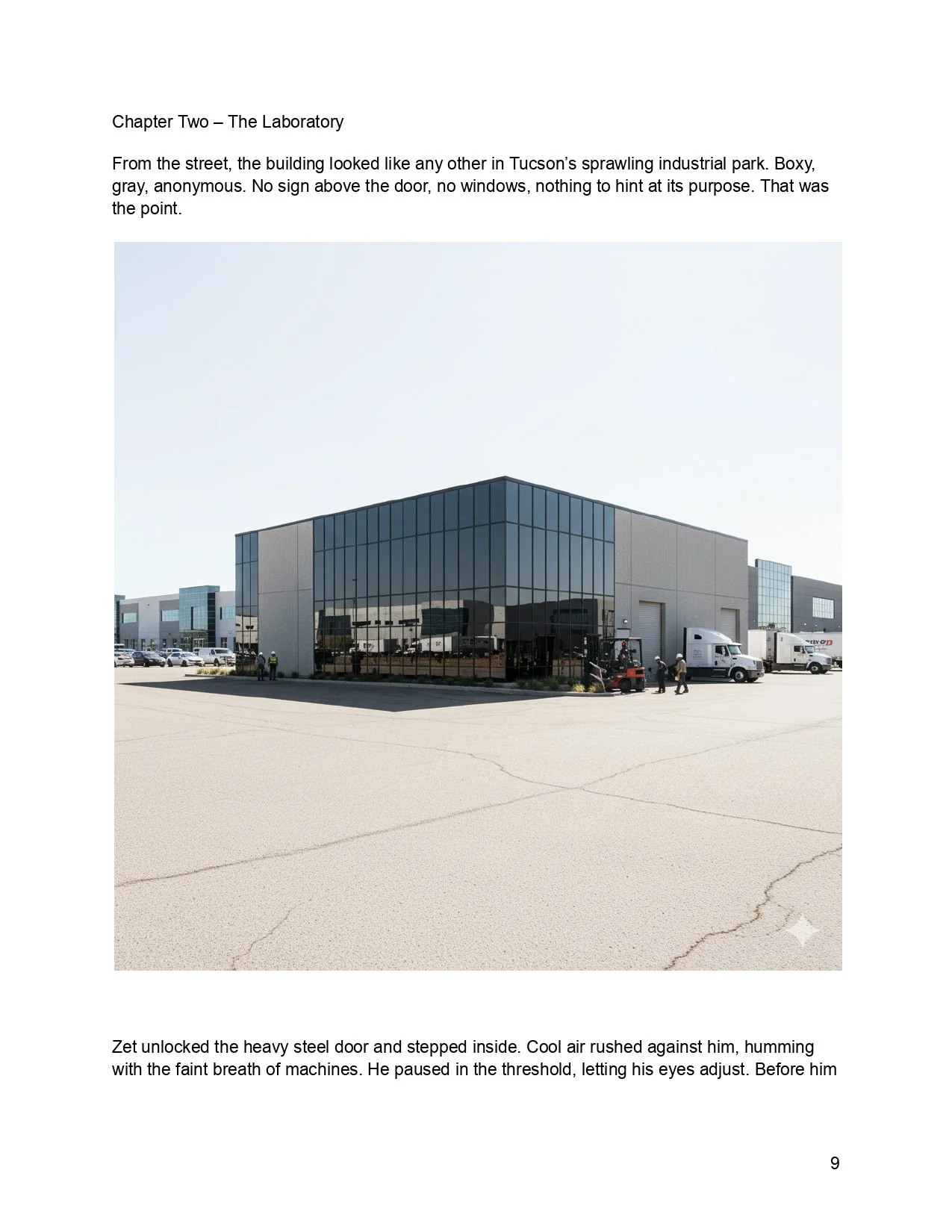
From the street, the building looked like any other in Tucson’s sprawling industrial park. Boxy, gray, anonymous. No sign above the door, no windows, nothing to hint at its purpose. That was the point.


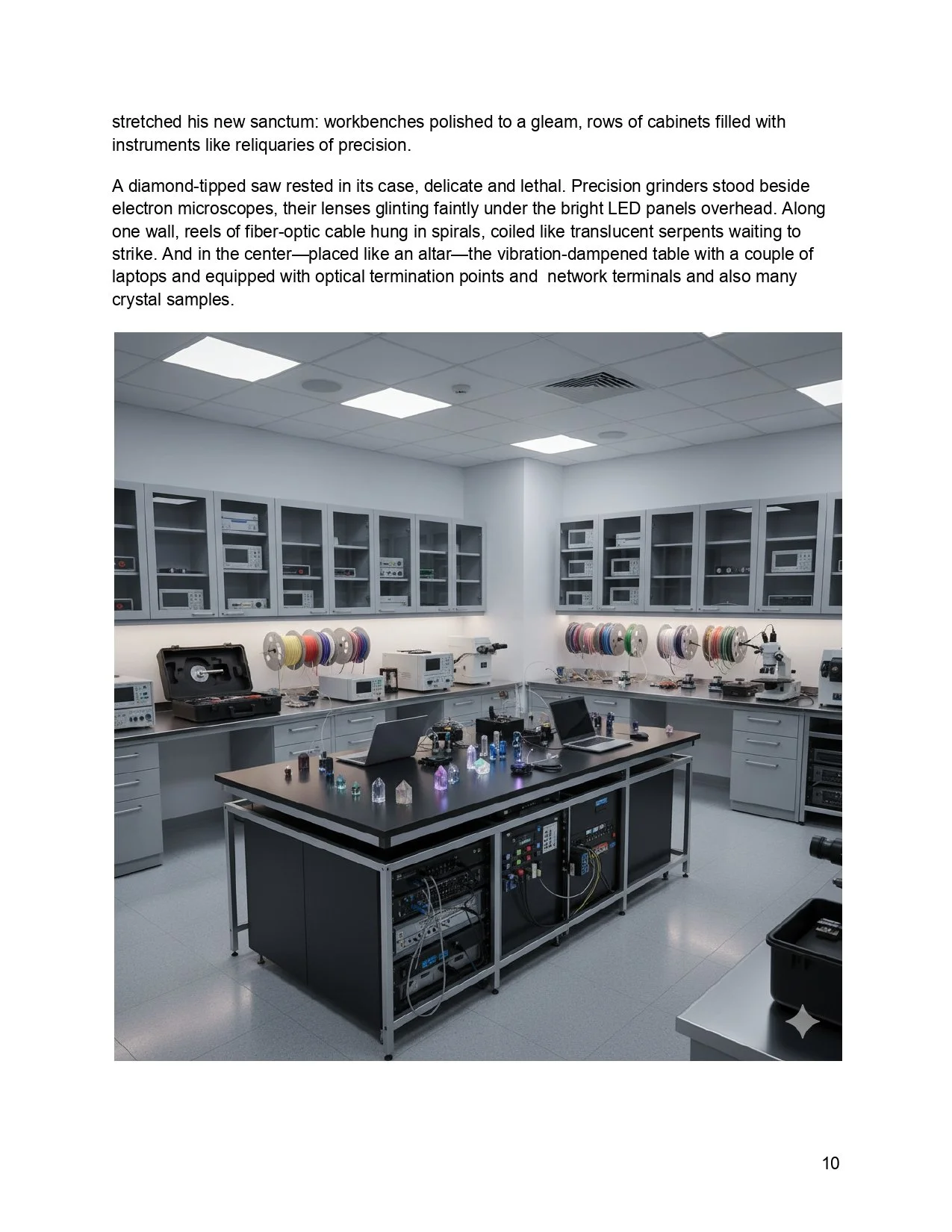
Zet unlocked the heavy steel door and stepped inside. Cool air rushed against him, humming with the faint breath of machines. He paused in the threshold, letting his eyes adjust. Before him stretched his new sanctum: workbenches polished to a gleam, rows of cabinets filled with instruments like reliquaries of precision.

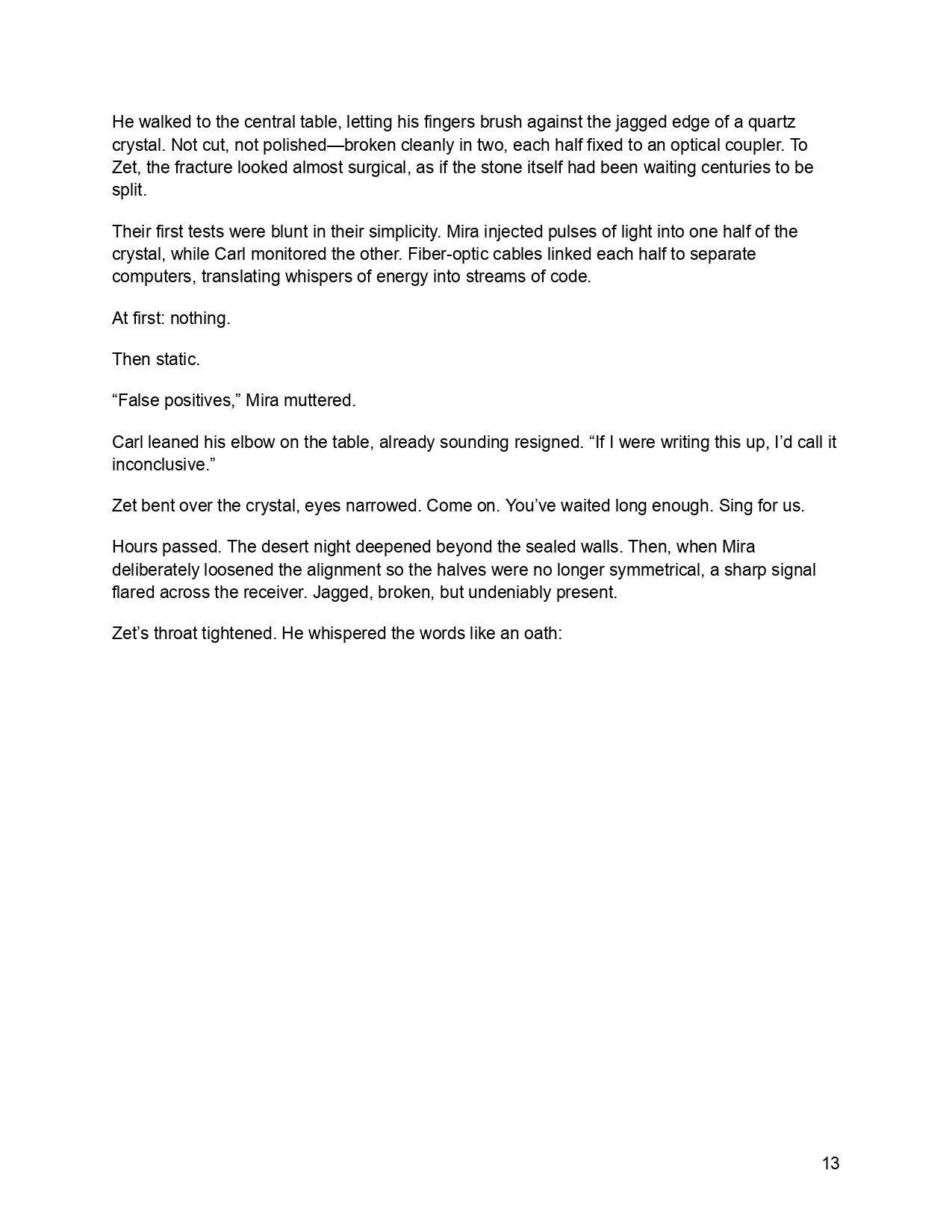
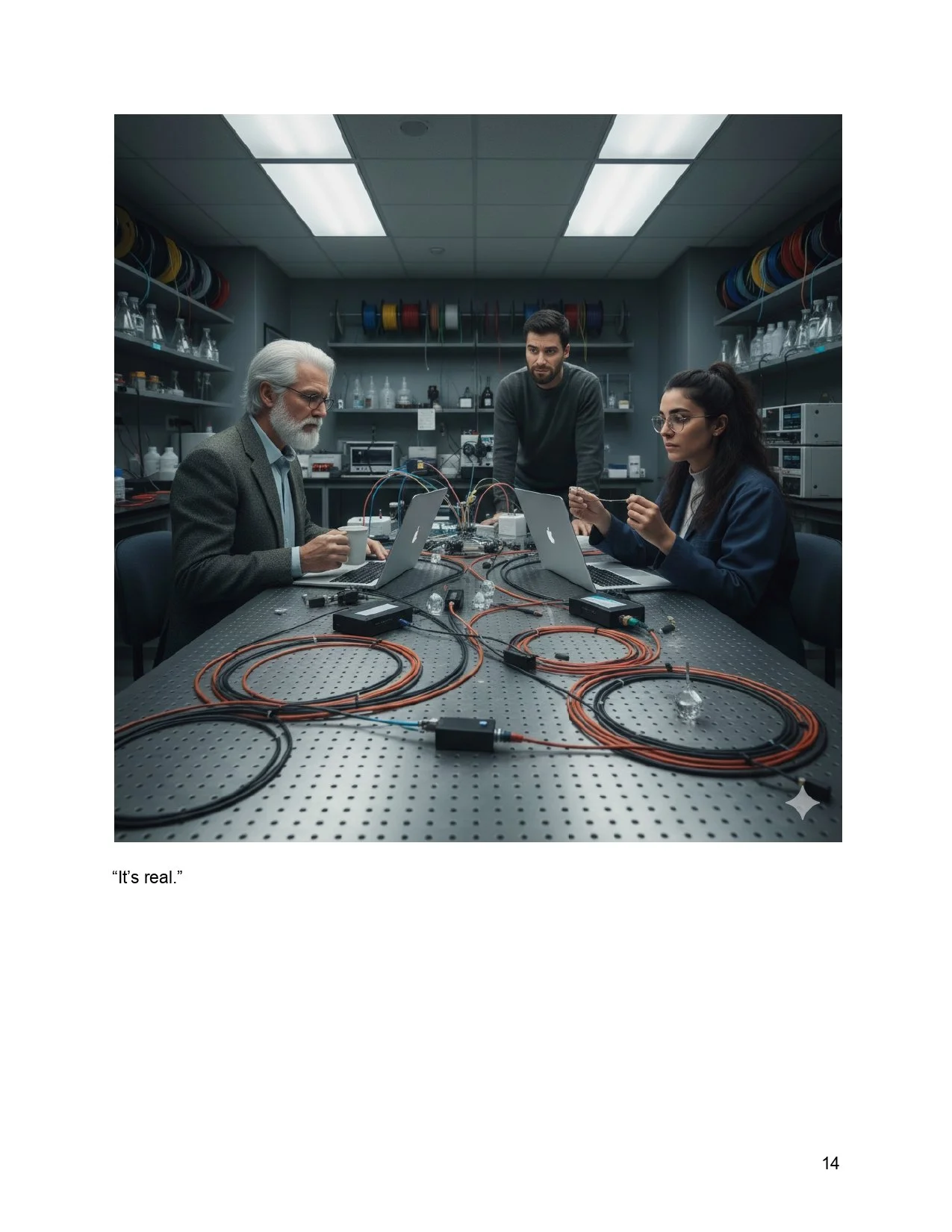
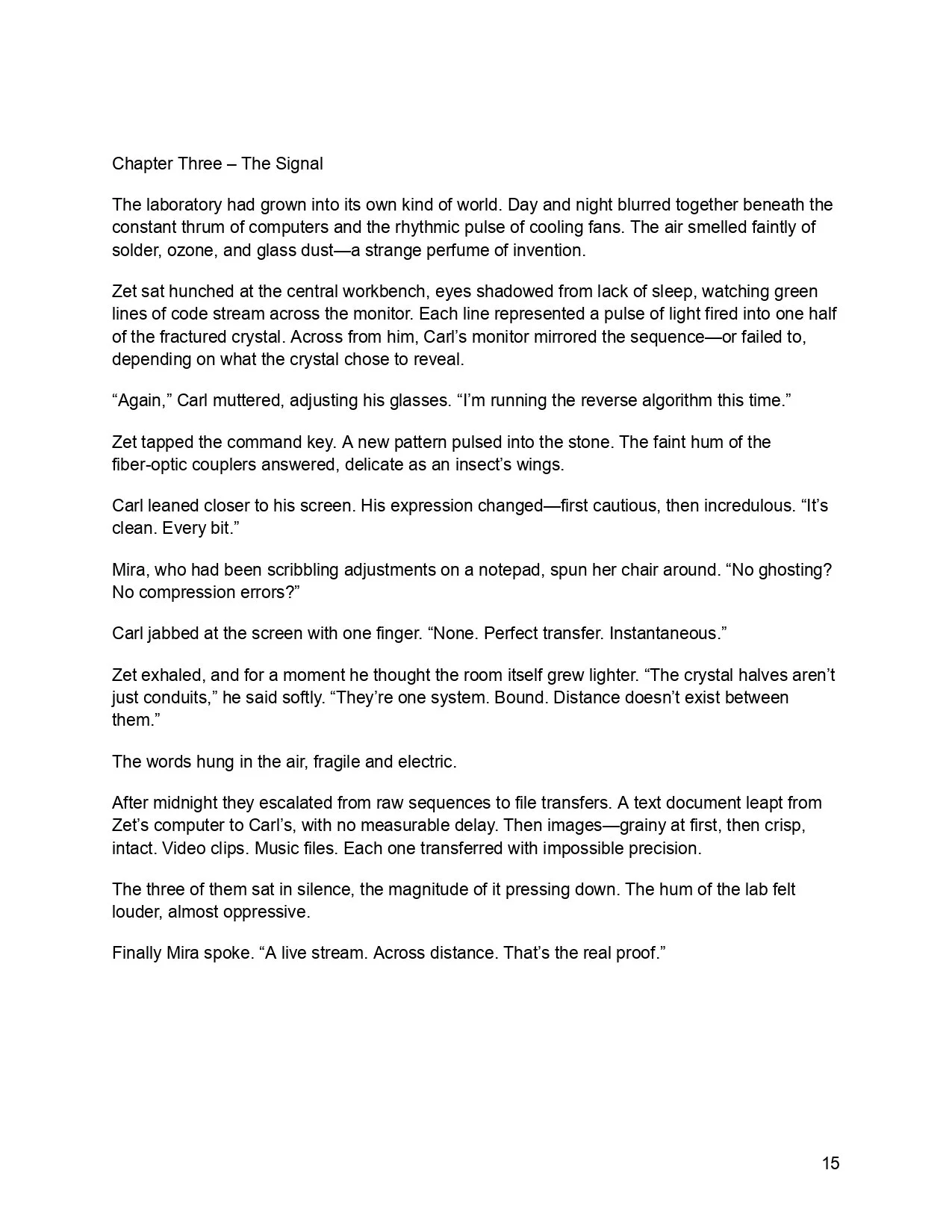
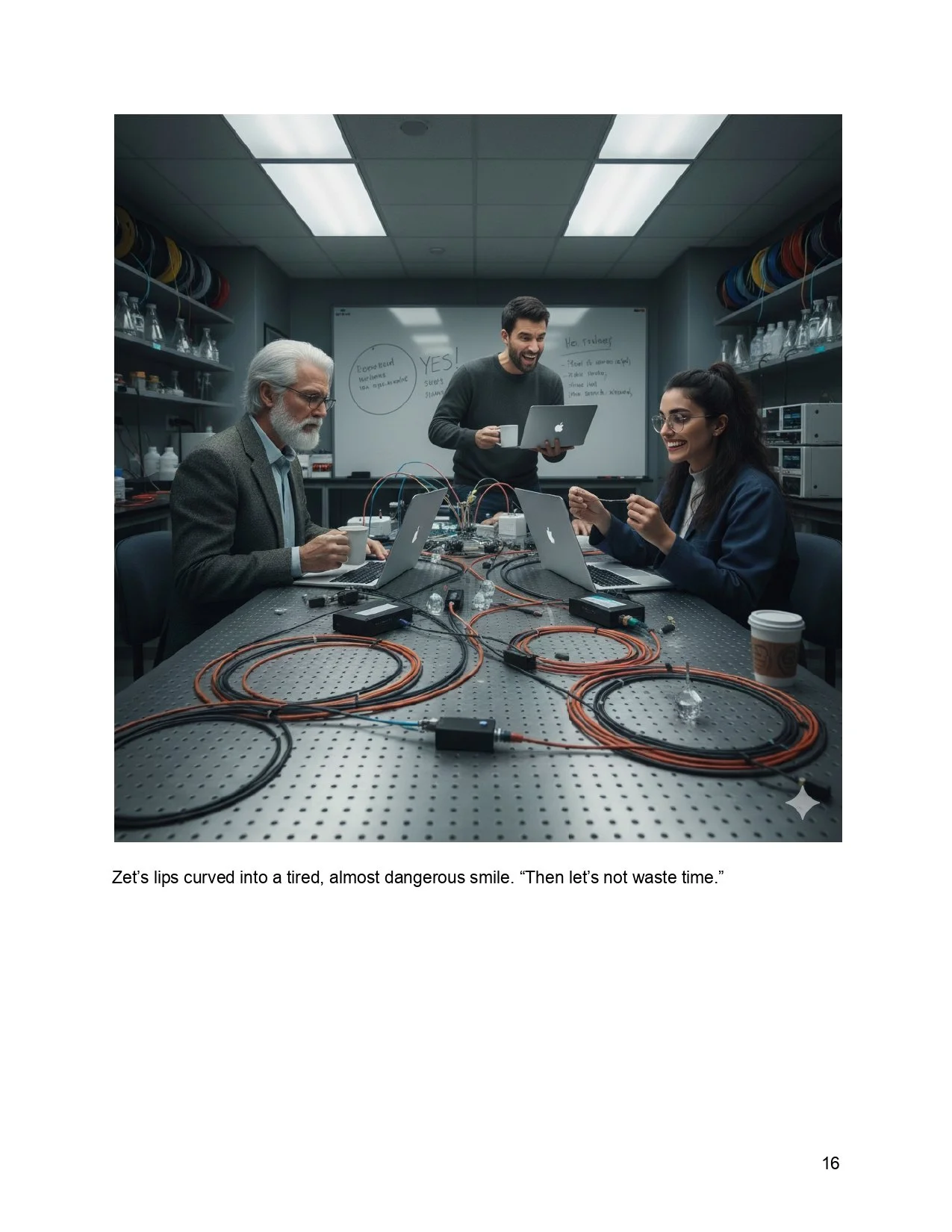
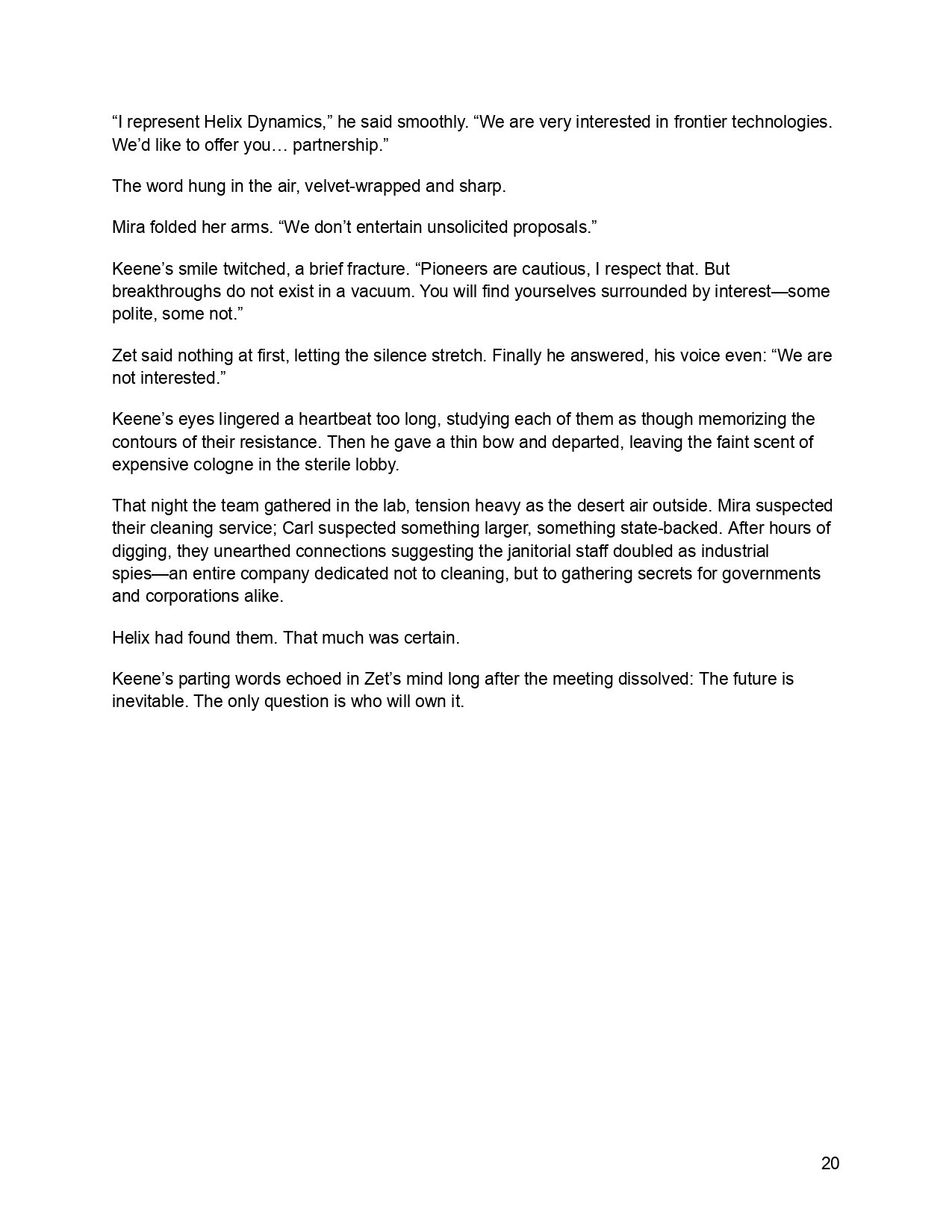
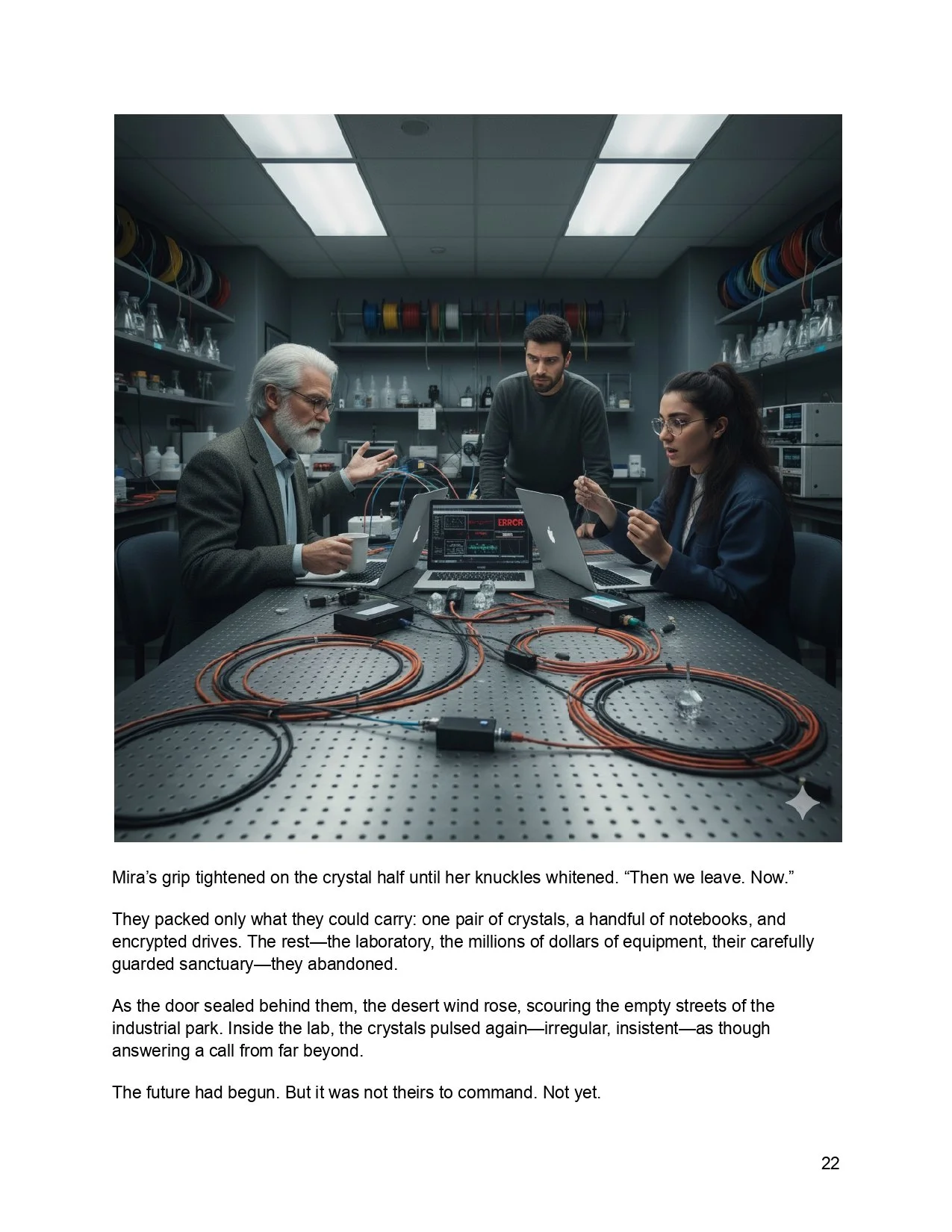
A diamond-tipped saw rested in its case, delicate and lethal. Precision grinders stood beside electron microscopes, their lenses glinting faintly under the bright LED panels overhead. Along one wall, reels of fiber-optic cable hung in spirals, coiled like translucent serpents waiting to strike. And in the center—placed like an altar—the vibration-dampened table with a couple of laptops and equipped with optical termination points and  network terminals and also many crystal samples.


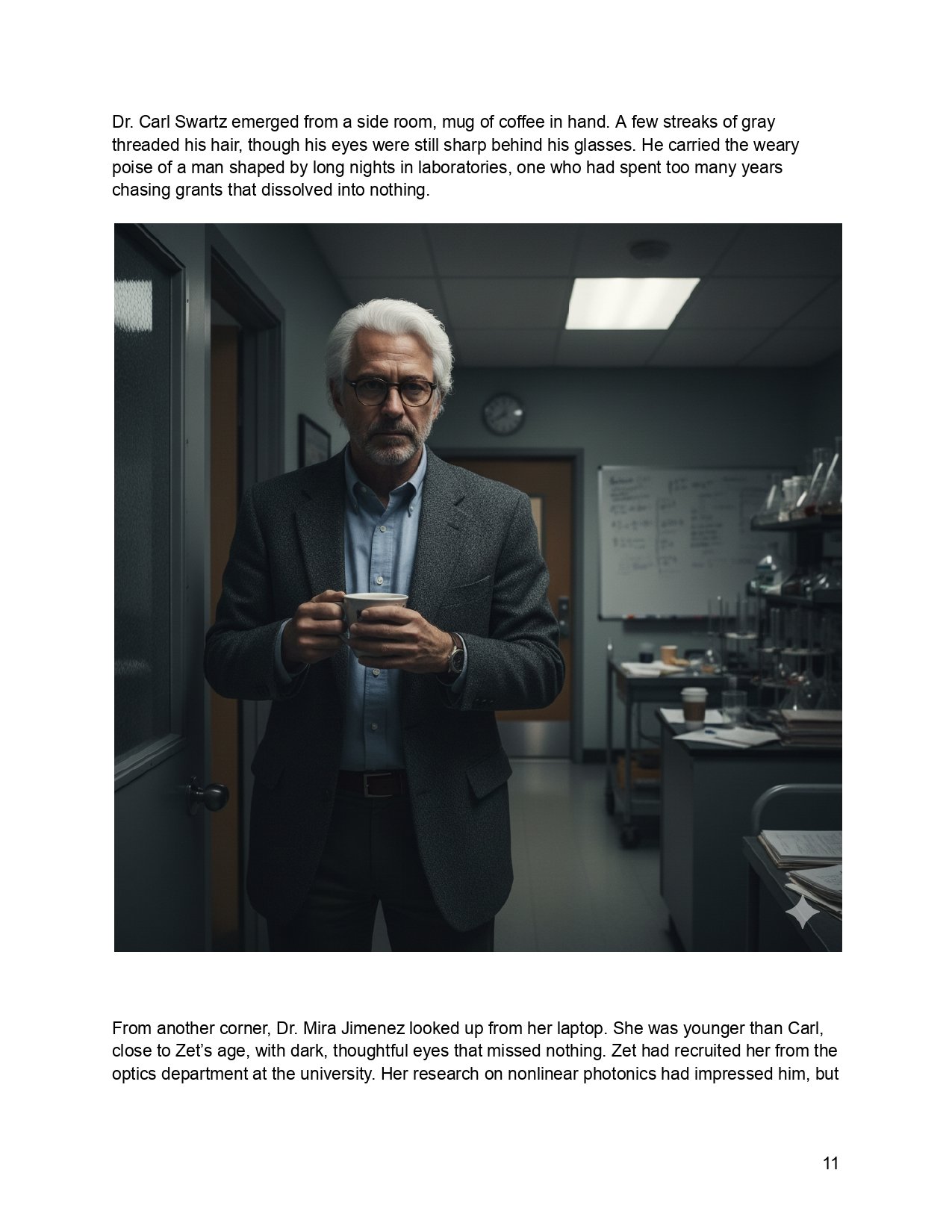
Dr. Carl Swartz emerged from a side room, mug of coffee in hand. A few streaks of gray threaded his hair, though his eyes were still sharp behind his glasses. He carried the weary poise of a man shaped by long nights in laboratories, one who had spent too many years chasing grants that dissolved into nothing.


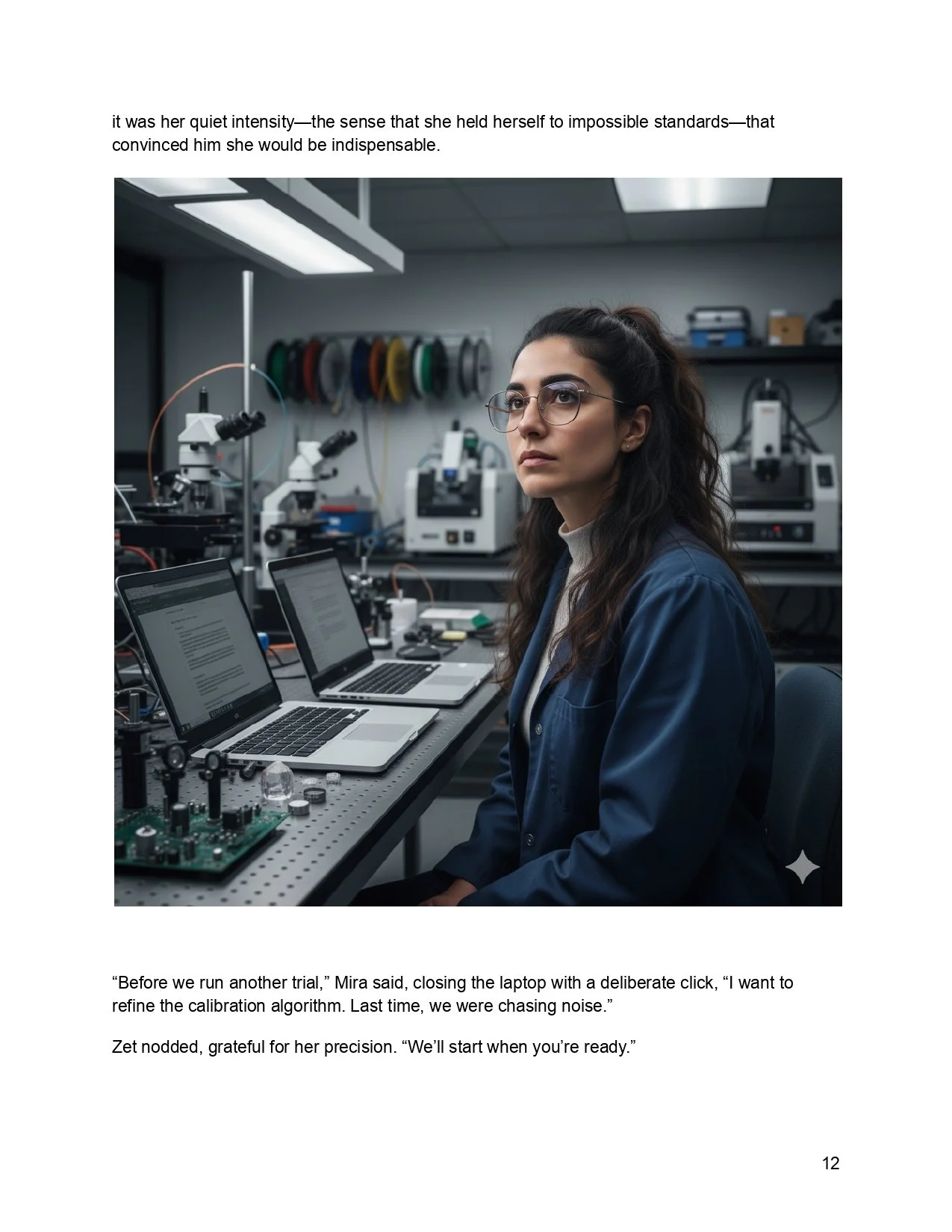
From another corner, Dr. Mira Jimenez looked up from her laptop. She was younger than Carl, close to Zet’s age, with dark, thoughtful eyes that missed nothing. Zet had recruited her from the optics department at the university. Her research on nonlinear photonics had impressed him, but it was her quiet intensity—the sense that she held herself to impossible standards—that convinced him she would be indispensable.


“Before we run another trial,” Mira said, closing the laptop with a deliberate click, “I want to refine the calibration algorithm. Last time, we were chasing noise.”

Zet nodded, grateful for her precision. “We’ll start when you’re ready.”

He walked to the central table, letting his fingers brush against the jagged edge of a quartz crystal. Not cut, not polished—broken cleanly in two, each half fixed to an optical coupler. To Zet, the fracture looked almost surgical, as if the stone itself had been waiting centuries to be split.

Their first tests were blunt in their simplicity. Mira injected pulses of light into one half of the crystal, while Carl monitored the other. Fiber-optic cables linked each half to separate computers, translating whispers of energy into streams of code.

At first: nothing.

Then static.

“False positives,” Mira muttered.

Carl leaned his elbow on the table, already sounding resigned. “If I were writing this up, I’d call it inconclusive.”

Zet bent over the crystal, eyes narrowed. Come on. You’ve waited long enough. Sing for us.

Hours passed. The desert night deepened beyond the sealed walls. Then, when Mira deliberately loosened the alignment so the halves were no longer symmetrical, a sharp signal flared across the receiver. Jagged, broken, but undeniably present.

Zet’s throat tightened. He whispered the words like an oath:


“It’s real.”


Chapter Three – The Signal

The laboratory had grown into its own kind of world. Day and night blurred together beneath the constant thrum of computers and the rhythmic pulse of cooling fans. The air smelled faintly of solder, ozone, and glass dust—a strange perfume of invention.

Zet sat hunched at the central workbench, eyes shadowed from lack of sleep, watching green lines of code stream across the monitor. Each line represented a pulse of light fired into one half of the fractured crystal. Across from him, Carl’s monitor mirrored the sequence—or failed to, depending on what the crystal chose to reveal.

“Again,” Carl muttered, adjusting his glasses. “I’m running the reverse algorithm this time.”

Zet tapped the command key. A new pattern pulsed into the stone. The faint hum of the fiber-optic couplers answered, delicate as an insect’s wings.

Carl leaned closer to his screen. His expression changed—first cautious, then incredulous. “It’s clean. Every bit.”

Mira, who had been scribbling adjustments on a notepad, spun her chair around. “No ghosting? No compression errors?”

Carl jabbed at the screen with one finger. “None. Perfect transfer. Instantaneous.”

Zet exhaled, and for a moment he thought the room itself grew lighter. “The crystal halves aren’t just conduits,” he said softly. “They’re one system. Bound. Distance doesn’t exist between them.”

The words hung in the air, fragile and electric.

After midnight they escalated from raw sequences to file transfers. A text document leapt from Zet’s computer to Carl’s, with no measurable delay. Then images—grainy at first, then crisp, intact. Video clips. Music files. Each one transferred with impossible precision.

The three of them sat in silence, the magnitude of it pressing down. The hum of the lab felt louder, almost oppressive.

Finally Mira spoke. “A live stream. Across distance. That’s the real proof.”

Zet’s lips curved into a tired, almost dangerous smile. “Then let’s not waste time.”


Chapter Four – Across the World

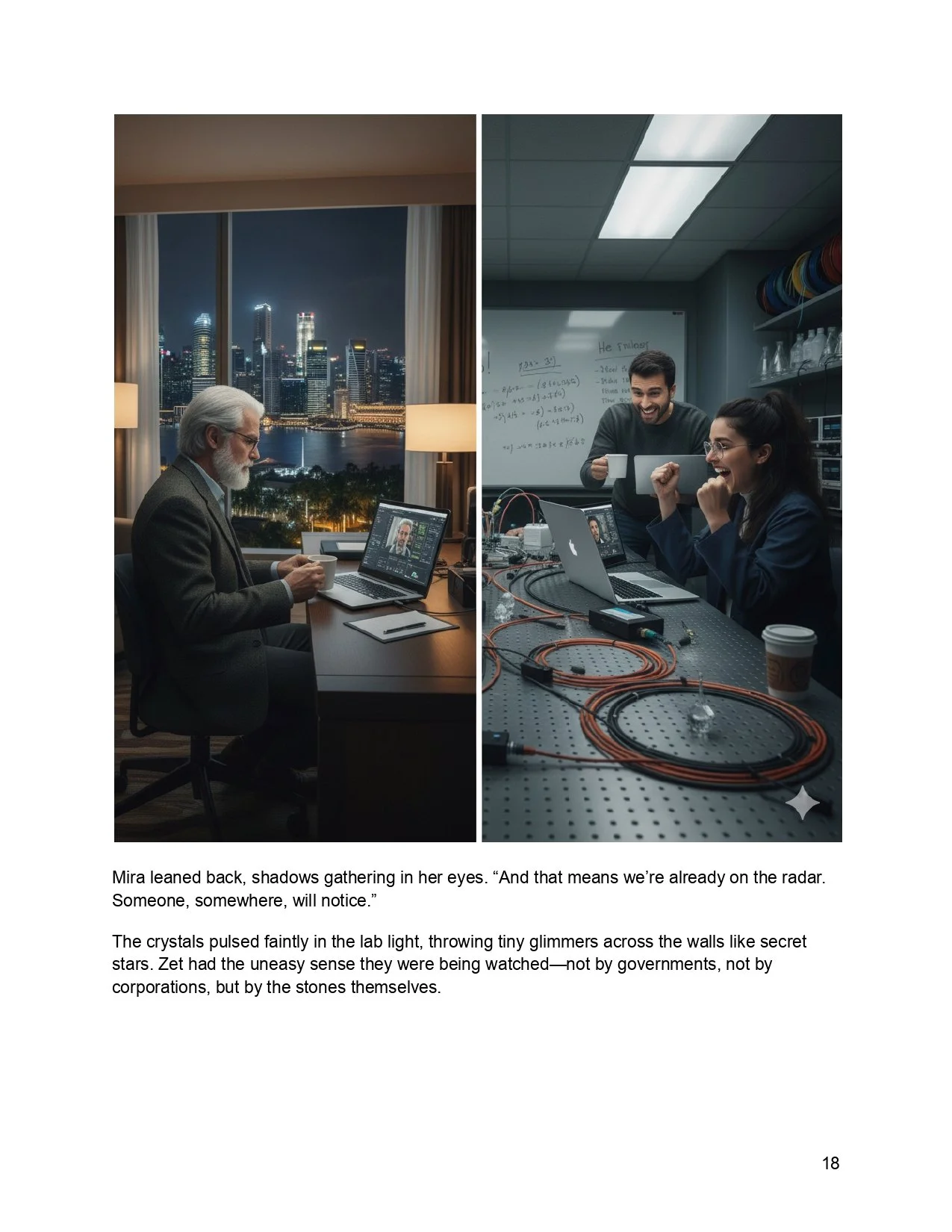
Two weeks later, the lab was filled with the pale blue glow of monitors, every screen tuned to the waiting feed.

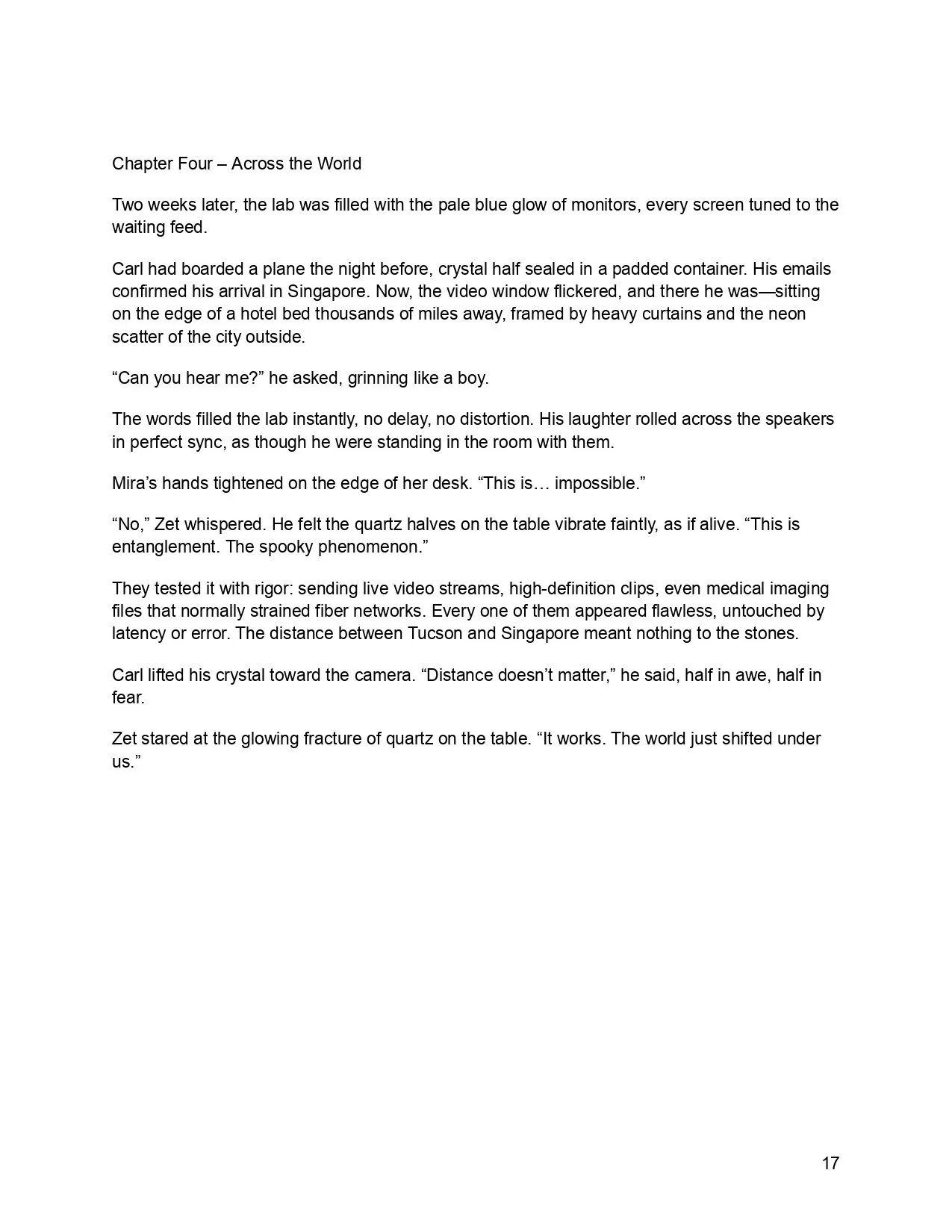
Carl had boarded a plane the night before, crystal half sealed in a padded container. His emails confirmed his arrival in Singapore. Now, the video window flickered, and there he was—sitting on the edge of a hotel bed thousands of miles away, framed by heavy curtains and the neon scatter of the city outside.

“Can you hear me?” he asked, grinning like a boy.

The words filled the lab instantly, no delay, no distortion. His laughter rolled across the speakers in perfect sync, as though he were standing in the room with them.

Mira’s hands tightened on the edge of her desk. “This is… impossible.”

“No,” Zet whispered. He felt the quartz halves on the table vibrate faintly, as if alive. “This is entanglement. The spooky phenomenon.”

They tested it with rigor: sending live video streams, high-definition clips, even medical imaging files that normally strained fiber networks. Every one of them appeared flawless, untouched by latency or error. The distance between Tucson and Singapore meant nothing to the stones.

Carl lifted his crystal toward the camera. “Distance doesn’t matter,” he said, half in awe, half in fear.

Zet stared at the glowing fracture of quartz on the table. “It works. The world just shifted under us.”

Mira leaned back, shadows gathering in her eyes. “And that means we’re already on the radar. Someone, somewhere, will notice.”

The crystals pulsed faintly in the lab light, throwing tiny glimmers across the walls like secret stars. Zet had the uneasy sense they were being watched—not by governments, not by corporations, but by the stones themselves.


Chapter Five – The Visitor

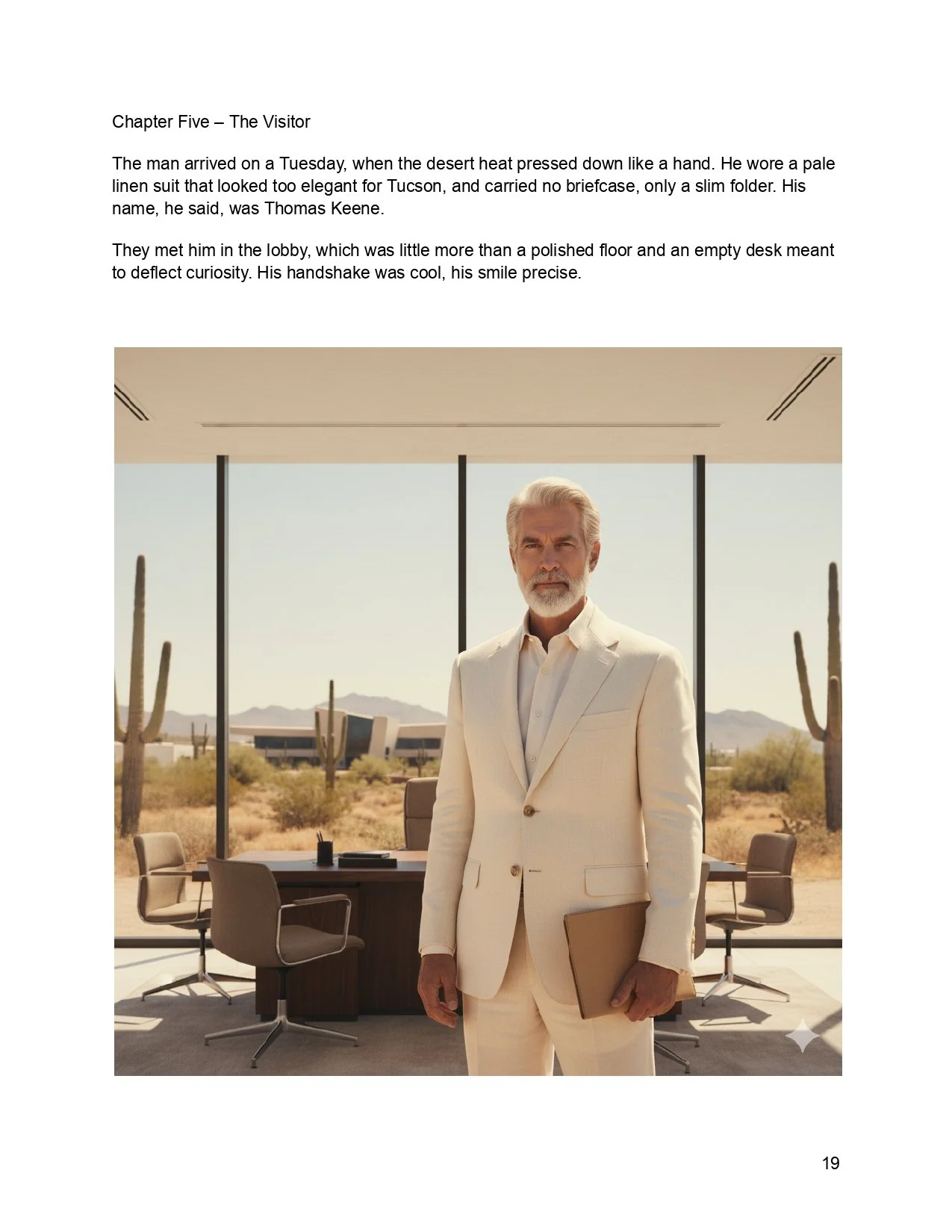
The man arrived on a Tuesday, when the desert heat pressed down like a hand. He wore a pale linen suit that looked too elegant for Tucson, and carried no briefcase, only a slim folder. His name, he said, was Thomas Keene.

They met him in the lobby, which was little more than a polished floor and an empty desk meant to deflect curiosity. His handshake was cool, his smile precise.


“I represent Helix Dynamics,” he said smoothly. “We are very interested in frontier technologies. We’d like to offer you… partnership.”

The word hung in the air, velvet-wrapped and sharp.

Mira folded her arms. “We don’t entertain unsolicited proposals.”

Keene’s smile twitched, a brief fracture. “Pioneers are cautious, I respect that. But breakthroughs do not exist in a vacuum. You will find yourselves surrounded by interest—some polite, some not.”

Zet said nothing at first, letting the silence stretch. Finally he answered, his voice even: “We are not interested.”

Keene’s eyes lingered a heartbeat too long, studying each of them as though memorizing the contours of their resistance. Then he gave a thin bow and departed, leaving the faint scent of expensive cologne in the sterile lobby.

That night the team gathered in the lab, tension heavy as the desert air outside. Mira suspected their cleaning service; Carl suspected something larger, something state-backed. After hours of digging, they unearthed connections suggesting the janitorial staff doubled as industrial spies—an entire company dedicated not to cleaning, but to gathering secrets for governments and corporations alike.

Helix had found them. That much was certain.

Keene’s parting words echoed in Zet’s mind long after the meeting dissolved: The future is inevitable. The only question is who will own it.


Chapter Six – Fault Lines

The lab was quieter than usual, as though the machines themselves were holding their breath. Outside, the desert wind stirred dust across the barren ground, whispering against the steel walls.

Carl lingered by the workbench, unease carved into his face. “They’ll offer everything,” he said finally. “Resources, recognition, an empire built overnight. We could go global in months.”

Mira’s hand rested on the crystal, her fingers tracing its fractured edge. “Or vanish into their basement and never be heard from again.”

Zet paced slowly, his thoughts jagged. “We’ve come too far to let them dictate this. The signal doesn’t just connect machines. It might connect… more. We don’t know the limits.”

The crystal pulsed faintly under the overhead lights. Not the steady rhythm of their own transmissions, not the clean logic of data. This was irregular, uneven, like a heartbeat struggling to break free.

Zet froze. “That’s not Helix.”

Carl leaned closer, his face pale. “Then who?”

Zet whispered, his mouth dry: “Not who. Maybe what.”

Mira’s grip tightened on the crystal half until her knuckles whitened. “Then we leave. Now.”

They packed only what they could carry: one pair of crystals, a handful of notebooks, and encrypted drives. The rest—the laboratory, the millions of dollars of equipment, their carefully guarded sanctuary—they abandoned.

As the door sealed behind them, the desert wind rose, scouring the empty streets of the industrial park. Inside the lab, the crystals pulsed again—irregular, insistent—as though answering a call from far beyond.

The future had begun. But it was not theirs to command. Not yet.

They fled into the desert with only what they could carry, their headlights cutting a narrow path across the empty highway. Behind them, the lab’s white hum and perfect sterility faded into memory, swallowed by shadows.

Yet even as the road unspooled ahead, the crystal in Zet’s backpack pulsed faintly, warm against the fabric, as if aware of its journey.

Carl broke the silence. “If it wasn’t Helix… if it wasn’t us… then who else is out there?”

Zet didn’t answer. He could feel something in the rhythm of the pulses—patterns too deliberate to be random, too alien to be human code. A call. A message. Perhaps even an invitation.

Mira’s eyes met his in the rearview mirror. “What if we weren’t the first?”

The desert stretched around them, vast and ancient. Above, the stars shimmered with cold fire, a million crystals burning in the void. Zet felt the weight of them pressing down, and for the first time, his theory seemed small compared to what might already be waiting.

The crystal flickered again, stronger this time. The pulse aligned with something unseen, far beyond the horizon.

Zet whispered into the night, more to himself than to the others:

“They’ve found us.”